
By Sami Chowdhury, Real Estate Broker | RE/MAX Realtron Realty Inc., Brokerage | November 24, 2026
Canada’s mortgage market is sending a warning that deserves attention, not panic. New credit data show that serious mortgage payment difficulties have increased even though the overwhelming majority of mortgage balances are not severely overdue. For Greater Toronto Area households, the most useful response is to understand their own exposure before a renewal, job disruption or unexpected expense takes away their flexibility.
Executive summary
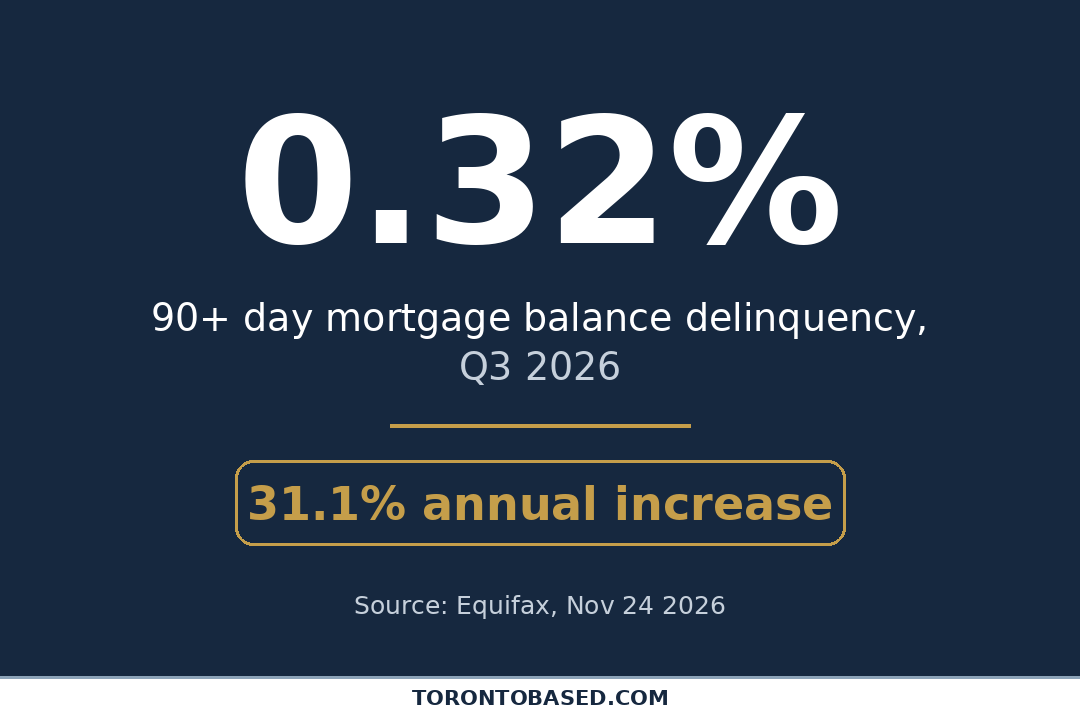
Equifax Canada reported on November 24 that the share of mortgage balances at least 90 days overdue stood at 0.32% in the third quarter of 2026, a 31.1% annual increase and the highest reading since its tracking began in 2013. Total consumer debt reached approximately $2.74 trillion, up 4.68% from a year earlier. Ontario and British Columbia drove much of the deterioration. [E, M]
These figures point to concentrated financial stress rather than evidence that every homeowner is struggling. The practical question is whether households can absorb their next payment change while still paying for necessities and maintaining an emergency reserve.
What the numbers actually mean
A balance-based delinquency measure is not the percentage of Canadians who have missed payments. It measures overdue mortgage balances relative to the relevant total. A balance can represent a large loan or a relatively small one, so a balance-weighted series cannot automatically be translated into a count of households.
The reported annual growth also needs context. Dividing 0.32% by 1.311 produces an approximate earlier rate of 0.244%. The difference is about 0.076 percentage points, or 7.6 basis points. Those are derived approximations, because the reported inputs are rounded. A striking relative increase and a small absolute rate can both be true.
Nor is a delinquent mortgage automatically a completed repossession or sale. Some borrowers may catch up, negotiate relief or arrange a sale voluntarily. Others may face enforcement. The data do not tell us which outcome will apply to a particular property.
Why payment pressure can appear years after a purchase
A mortgage term and its amortization are different. The term is the contractual period for the current arrangement; amortization is the schedule over which the debt would be repaid. A household may have purchased years ago, made every payment and then face a different interest rate when its term expires.
Fixed-rate borrowers are generally protected from changes to their contractual rate during the term. Variable-rate borrowers can experience changes sooner, depending on whether their payments adjust or the allocation between principal and interest changes. The consequences depend on the contract. A borrower should ask the lender for the actual renewal payment and remaining amortization rather than infer them from a headline about the overnight rate.
Consider a family with a mortgage, vehicle financing, childcare costs and a modest savings buffer. Even a manageable increase in the mortgage payment can become difficult if insurance, utilities or other necessary expenses rise at the same time. A household that had no trouble meeting its obligations when it bought may find its budget stretched without any change in its spending habits.
The Bank of Canada’s 2026 assessment provides a useful counterweight: most renewing borrowers had absorbed increases, while a subset with high debt burdens remained vulnerable. [B] This is why a national average cannot substitute for an individual budget.
Why Ontario and the GTA deserve attention
The GTA includes high-cost housing markets and a wide range of household incomes. A large mortgage can make even a small rate change consequential in dollar terms. Recent purchasers who made a modest down payment may also have less equity available if their local market value has fallen.
That does not mean every Toronto condominium, suburban townhouse and detached home faces the same selling pressure. The relevant comparison is the local pool of competing listings, recent comparable sales, buyer qualification and the particular property's features. A neighbourhood with scarce family-sized homes can behave differently from a market segment with substantial competing inventory.
For a homeowner considering a move, a national credit statistic is a reason to investigate, not a valuation method. A comparative market analysis should look at recent completed transactions, distinguish asking prices from achieved prices and account for condition, size, parking, maintenance fees and location.
Income, debt and equity: three different problems
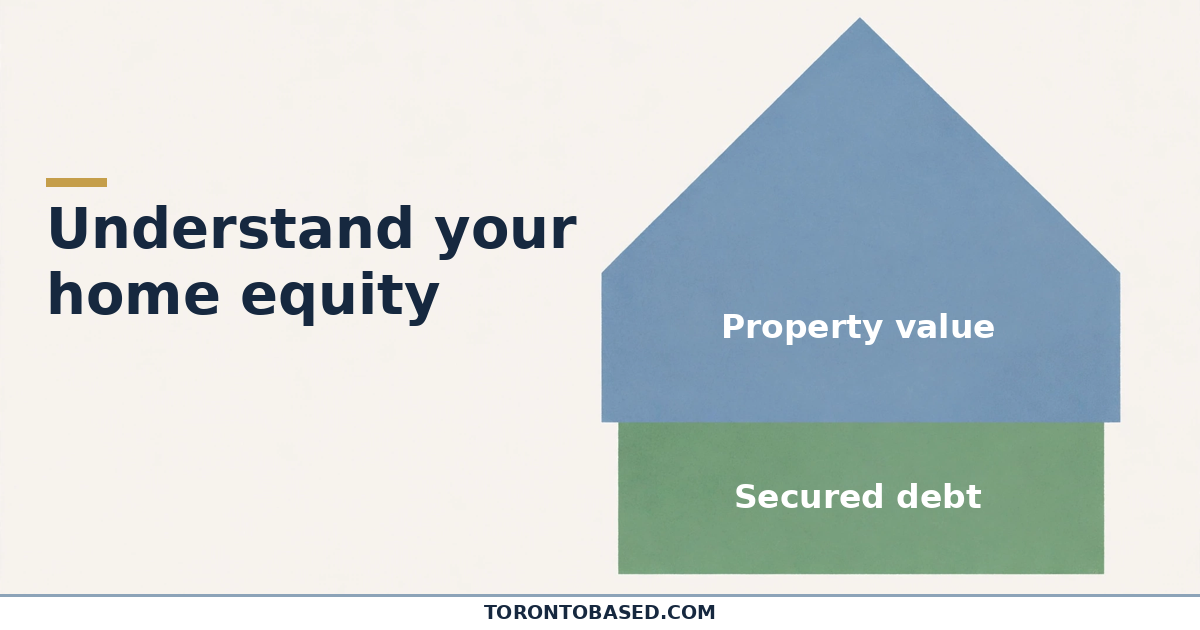
Cash flow is the money left after necessary expenses. Equity is the difference between property value and secured debt, before selling costs. Liquidity is the money available when a payment is due. These concepts are related but not interchangeable.
A homeowner can have substantial equity yet insufficient cash to pay a mortgage this month. Another can make all scheduled payments while having very little equity. A third may have good income but face a temporary interruption due to illness, unemployment or reduced working hours. Each requires a different discussion.
For a simple illustration, a home worth $900,000 with a $600,000 mortgage has $300,000 in gross equity. If its value falls to $800,000, gross equity falls to $200,000, before other liens and selling expenses. This is not a Toronto price forecast; it demonstrates why a property valuation and a current mortgage statement are needed before deciding whether a move is feasible.
A homeowner should distinguish an advertised mortgage rate from the actual rate offered on renewal and confirm whether there are penalties, discharge charges or restrictions. Even a lower payment may increase lifetime borrowing costs if the repayment period is lengthened.
How higher delinquency could affect housing supply
There are several plausible channels. A financially stretched owner may decide to sell voluntarily, increasing listings. A lender may agree to a temporary adjustment, delaying or avoiding a sale. An owner may stay in place because alternative housing costs are also high. A buyer may reduce their target purchase price to protect monthly cash flow.
These channels do not operate at the same speed. Listings can change quickly, while a formal mortgage enforcement process is subject to legal requirements and may take time. Sales volumes, inventory and prices respond to many influences besides mortgage stress, including employment, construction, immigration, household formation and available credit.
The result is not predetermined. An increase in listings without a similar increase in qualified buyers could put pressure on prices. But a market with strong demand or limited supply could absorb additional listings. The same national statistic can coexist with different outcomes across the GTA.
A useful monitoring approach is to compare active listings, new listings, sold properties and days on market by property type and municipality. Where reliable data exist, monitor the share of listings explicitly identified as lender sales separately. Do not classify ordinary motivated sellers as distressed without evidence.

A practical homeowner renewal plan
Begin by locating the mortgage agreement, latest statement and maturity date. Confirm the remaining principal, payment frequency, current interest rate, and whether any secured line of credit is attached to the property. Request written renewal estimates rather than relying on online advertisements.
Next prepare a household budget using take-home income. Include property tax, utilities, insurance, maintenance, condominium fees where applicable, transportation, groceries, child or elder care and other debt payments. Separate necessary spending from optional expenses, while allowing a realistic reserve for irregular costs.
Run at least three scenarios: the lender’s quoted payment, a higher payment and a temporary reduction in income. This is not a prediction of interest rates. It is a test of whether the household has enough flexibility if conditions change. A scenario that only works when every expense remains unchanged is fragile.
If a shortfall appears, contact the lender before missing a payment. Ask about available hardship arrangements and their total cost. Obtain written terms, including how deferred amounts or interest are treated. FCAC explains potential relief mechanisms, but access depends on the institution, contract and individual circumstances. [F]
A mortgage professional can help compare renewal or refinancing options. A real estate broker can estimate current market value, competing supply and likely transaction costs. A lawyer can explain legal rights and obligations, particularly when formal notices have been received. These are complementary roles, not substitutes for one another.
Should a homeowner refinance, downsize or sell?
Refinancing may help restructure debt or adjust payments, but eligibility is not guaranteed. It can involve new qualification, appraisal costs, fees and additional interest. Using home equity to pay consumer debt may convert unsecured borrowing into debt secured against the home. The affordability of the new arrangement matters more than the immediate reduction in monthly payments.
Downsizing can reduce some expenses, but it is not automatically cheaper. Compare the net proceeds from a sale with the cost of buying or renting another home. A condominium may have lower maintenance responsibilities but monthly fees and potential special assessments. A smaller detached home might still carry significant taxes and repair costs. Moving costs and temporary accommodation also belong in the analysis.
A voluntary sale may preserve flexibility if staying is no longer affordable, especially when there is sufficient time to market the property properly. But selling is a major decision. A homeowner should compare the costs of staying, restructuring and moving, and obtain advice where appropriate. A market valuation is not an instruction to list.

What first-time buyers should do differently
A preapproval is useful, but the maximum offered loan should not necessarily become the household's target. Lender qualification does not capture every personal expense, future family plan or tolerance for financial uncertainty. A buyer should build a budget from actual take-home pay and expected ownership costs.
When reviewing a condominium, examine the status certificate with a lawyer, including reserve fund information, fees, insurance and known litigation or assessments. For a freehold property, allow for roof, heating, plumbing and other repairs. A lower purchase price can still produce a higher total cost if the home needs substantial work.
Maintain an emergency reserve after closing. Closing expenses can include land transfer taxes, legal fees, adjustments, moving and immediate repairs. First-time buyers should verify eligibility for any rebates or programs rather than assume they apply. A purchase that consumes all available cash can leave a household exposed to even a modest financial shock.
How sellers can plan without reacting to headlines
A seller with a comfortable mortgage payment and no immediate need to move has a different negotiating position from an owner who faces a renewal within weeks. Start with the reason for selling and the timeline. A pricing strategy should reflect current comparable evidence and the costs of carrying the home for longer, not the price that would be most convenient for the owner.
Ask for an estimated net proceeds statement. It should account for the mortgage payout, any other secured debts, brokerage fees and applicable tax, legal expenses and other transaction adjustments. A mortgage payout quote may differ from the balance shown on a statement because of accrued interest, penalties or fees.
If a sale is financially necessary, discuss realistic marketing timelines with the broker and obtain advice promptly if enforcement is threatened. Avoid promising a lender a completion date that depends on finding a buyer or satisfying conditions that have not yet been resolved.
Investors: measure resilience rather than appreciation
Rental property cash flow should include financing, property taxes, insurance, repairs, vacancy, management, utilities where paid by the owner and an allowance for major capital work. Rent should be based on lawful and supportable assumptions, not a hoped-for increase.
A property that produces a small surplus at current financing costs may become cash-flow negative at renewal. An investor should assess the ability to fund that shortfall without relying on an immediate resale or future appreciation. Financing and tax questions belong with qualified professionals.
What the report cannot establish
It cannot establish how many GTA homes will be listed because of mortgage arrears, how many owners will enter power of sale, or what Toronto prices will do next. It does not identify the personal circumstances of borrowers. It also does not prove that a single policy decision caused all of the increase.
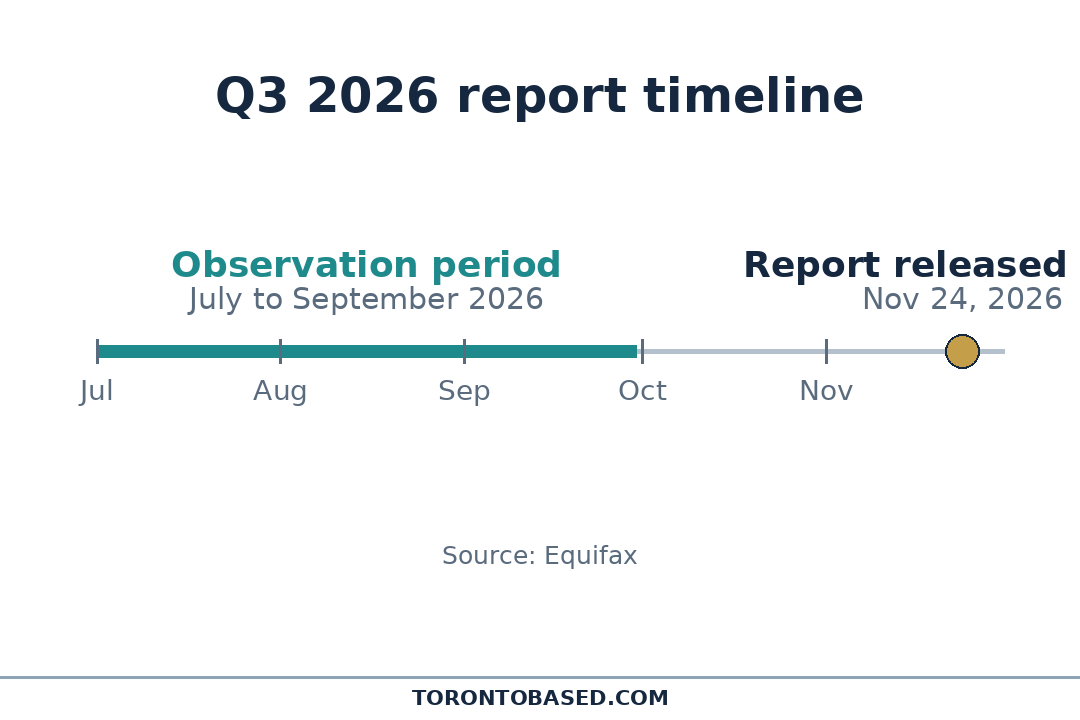
The Q3 observation covers July through September. The publication is dated November 24. Events after September should not be described as causes of the measured quarter without additional evidence. Later interest-rate changes may influence future outcomes, but that is a separate question.
Questions readers are asking
Is a 13-year high the same as an all-time record? No. It is the highest figure in the specified Equifax series, which begins in 2013.
Does the rate mean that one in three mortgage holders is behind? No. The 31.1% number is annual relative growth, not the proportion of borrowers.
Can I sell before renewal? Potentially, depending on timing, contract terms and the market. Obtain a payout quote and evaluate the net proceeds.
Will prices fall because of this report? The report alone cannot answer that. Local supply, demand and credit conditions must be considered.
What should I do if I cannot make my next payment? Contact your lender promptly, explain the circumstances and ask for written options. Seek independent professional help where necessary.
Bottom line
The latest mortgage data should encourage preparation, not alarm. Review your renewal date, realistic budget, available equity and housing alternatives while you still have choices. For a confidential real estate market and home-equity review, contact Sami Chowdhury through TorontoBased.com. Financing and legal advice should come from the appropriately qualified professionals.
Sources and further reading
[E] Equifax Canada, Q3 2026 release, November 24, 2026: https://www.equifax.ca/about-equifax/newsroom/-/intlpress/rising-interest-rates-could-put-nearly-1-in-4-mortgage-holders-at-risk-of-added-financial-stress-as-mortgage-delinquencies-reach-13-year-high
[B] Bank of Canada, Financial Stability Report 2026, households: https://www.bankofcanada.ca/publications/financial-stability-report/financial-stability-report-2026/households/
[C] CMHC, Residential Mortgage Industry Report, Fall 2026: https://www.cmhc-schl.gc.ca/professionals/housing-markets-data-and-research/housing-research/research-reports/housing-finance/residential-mortgage-industry-report
[F] FCAC, Mortgage relief options: https://www.canada.ca/en/financial-consumer-agency/services/mortgages/relief-options.html
[O] OSFI, Annual Risk Outlook 2026–2027: https://www.osfi-bsif.gc.ca/en/about-osfi/reports-publications/osfis-annual-risk-outlook-fiscal-year-2026-2027
[G] Global News, November 24, 2026: https://globalnews.ca/news/12164175/mortgage-delinquencies-2026/
[M] Canadian Mortgage Professional, November 24, 2026: https://www.mpamag.com/ca/mortgage-industry/market-updates/mortgage-delinquency-hits-13-year-high/598660
GTA real estate insights & resources
📊 Market insights
Toronto & GTA Housing Market — OCT 2026
Rent vs Own in Toronto (2026): What Happens After 25 Years? A Real Numbers Breakdown!
Renting vs. Owning: How $2,500/month could cost you $190,000
GTA Housing — GTA Buyer Guide 2026
Mississauga Condo Market — Q3 2025
Durham Region Market Report — Oct 2025
Bill 60 vs Ontario RTA — What’s Changing?
Read more market reports & analysis →
🔍 Property search resources
Gas Stations for Sale | Commercial & Industrial Properties
Residential Homes Across the GTA | Hotels & Motels – Investment Opportunities
Pre-Construction Condo Projects | Condo Resale Listings (GTA)
About the author
Sami Chowdhury | Broker
RE/MAX Realtron Realty Inc., Brokerage
samichy@torontobase.com | torontobased.com | torontobase.ca
209–885 Progress Ave, Toronto, ON M1H 3G3
Direct: 647-725-0606 | Office: 416-289-3333 | Fax: 416-289-4535
🏡 What could your home sell for today?
Get a personalized, comparable-sales-based price range for your GTA property. No pressure or obligation.