RSS

Canada's Unemployment Rate Reaches 6.7%: What Does It Mean for Toronto and GTA Home Prices?

Published: November 13, 2026

Canada's labour market is showing signs of weakness, raising important questions for the housing market.

Statistics Canada's October 2026 Labour Force Survey reported that the national unemployment rate increased to 6.7%, while employment was essentially unchanged.

For homeowners, buyers and investors in the Greater Toronto Area, these developments matter because housing demand depends on more than mortgage interest rates.

It also depends on income, employment security and confidence in the future.

What Did October's Employment Report Show?

Canada's employment declined by approximately 4,700 jobs during October.

Although the monthly change was relatively small, the unemployment rate increased from 6.5% to 6.7%.

The unemployment increase reflected more people looking for employment without finding work.

The national employment rate declined to 60.5%, marking its third consecutive monthly decrease.

Other important findings included:

  • Youth unemployment increased to 13.7%.

  • Wholesale and retail trade employment declined by approximately 29,000.

  • Construction employment increased by approximately 16,000.

  • Educational-services employment increased by approximately 15,000.

  • Average hourly wages rose 2.2% year over year.

In Ontario, the unemployment rate increased to 7.3%, while total employment remained relatively stable.

These figures indicate labour-market caution, not a collapse in overall employment.

Why Employment Matters to the GTA Housing Market

Buying a home is usually one of the largest financial commitments a household makes.

Even when people have enough income to qualify for a mortgage, they may delay purchasing if they are concerned about layoffs, declining business revenue or reduced opportunities for career advancement.

This means lower home prices do not automatically generate stronger housing demand.

A buyer considering a $900,000 home may prefer to remain in a rental property until employment conditions become more predictable.

Similarly, homeowners considering moving into a larger property may postpone selling and purchasing if they are uncertain about their household income.

What Do the Latest GTA Housing Numbers Show?

TRREB reported 5,603 home sales during October 2026, down 7.9% from October 2025.

The average selling price was $1,024,108, down 2.7% year over year.

New listings were also down 11.9%.

Although seasonally adjusted sales and prices improved slightly from September, the market remained below year-earlier levels.

TRREB identified economic uncertainty, inflation and borrowing costs as significant influences on buyer confidence.

October's employment report adds another reason to monitor household financial confidence carefully.

Could Higher Unemployment Lead to Lower Interest Rates?

A weaker labour market can reduce pressure on a central bank to raise interest rates.

However, it does not guarantee lower mortgage rates.

The Bank of Canada must also consider inflation, economic growth and financial conditions.

Canada experienced renewed inflation pressure during 2026, particularly from higher energy prices.

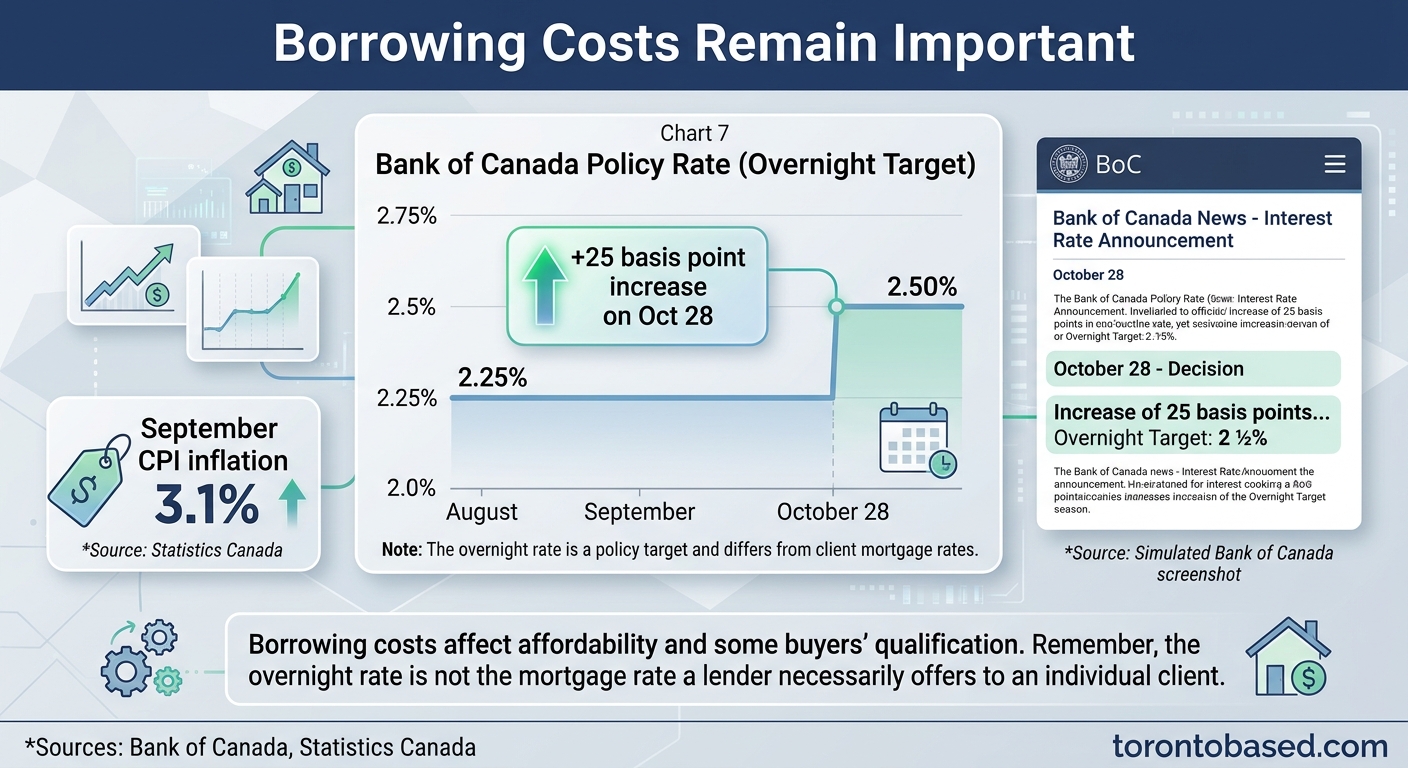
As a result, the Bank increased its policy rate to 2.50% on October 28.

Future rate decisions will depend on whether inflation remains persistent and whether economic weakness becomes more widespread.

Fixed mortgage rates also respond to bond markets and lender funding conditions.

What Does This Mean for Sellers?

Sellers should expect buyers to pay close attention to affordability and property condition.

Homes that require substantial repairs or carry unusually high monthly expenses may face additional resistance.

Competitive pricing, accurate property information and professional presentation become especially important when buyer confidence is weak.

However, individual neighbourhoods may behave differently.

A well-priced detached home in Scarborough could experience different demand from a downtown investment condominium.

What Does This Mean for Buyers?

Financially secure buyers may find opportunities in markets where sellers are more willing to negotiate.

But purchasing should depend on realistic affordability, not speculation about where prices will go next.

Buyers should consider mortgage payments, property taxes, insurance, maintenance and emergency savings.

A lower purchase price is beneficial only when the complete financial commitment remains manageable.

What Does This Mean for Investors?

Rental-property investors should consider both employment risk and rental demand.

A tenant's employment stability may affect rental-payment risk, while broader labour-market weakness can influence household formation and the demand for housing.

Properties should be evaluated using realistic rental income, vacancy assumptions, financing costs and operating expenses.

Final Thoughts

Canada's 6.7% unemployment rate is an important economic signal, but it does not independently determine the direction of GTA home prices.

The more useful approach is to examine employment trends alongside mortgage rates, inventory, comparable sales and household affordability.

The strongest real estate decisions are based on property-specific evidence and financial readiness—not national headlines alone.

Sami Chowdhury
Broker | RE/MAX Realtron Realty Inc., Brokerage
TorontoBased.com

For a neighbourhood-specific GTA housing market review, contact us to discuss your buying or selling plans.

Read

Toronto's Spring House: A New Approach to Affordable Housing, Health Care and Urban Development

Published: November 13, 2026

Toronto's housing challenges extend beyond the cost of purchasing a home. For seniors, vulnerable residents and people experiencing chronic homelessness, stable housing is often closely connected to access to health care and social support.

A new supportive housing project in Parkdale, known as Spring House, demonstrates how Toronto is beginning to address these challenges through partnerships between government, health-care institutions and housing developers.

The project also offers a glimpse into how future affordable housing could be designed and delivered.

What Is Spring House?

Spring House is a planned eight-storey supportive housing development located at 1–3 Close Avenue and 78 Springhurst Avenue in Toronto's Parkdale neighbourhood.

The project will provide 54 studio homes, prioritizing seniors and older adults experiencing chronic homelessness and complex health needs.

Each apartment will include a private kitchen and bathroom. Residents will also have access to shared spaces, community programming and on-site staff available 24 hours a day.

The project is being delivered by CreateTO on behalf of the City of Toronto, in partnership with University Health Network. It is supported by federal, provincial and municipal resources.

Construction is anticipated to begin in late 2026, with completion targeted for 2028.

Housing and Health Care Under One Roof

Spring House builds on the Social Medicine Housing Model introduced at Dunn House, located at 90 Dunn Avenue.

The underlying idea is that stable housing can improve health outcomes when residents also receive convenient access to medical and social services.

According to information released by the City of Toronto, early results at Dunn House showed a 52% reduction in emergency department visits and a 79% reduction in hospital bed days among participating residents.

These results suggest that supportive housing may help reduce pressure on hospitals while improving residents' stability and well-being.

However, the results come from a specific program and should not automatically be assumed for every future supportive housing project.

Why Construction Methods Matter

Spring House has also attracted attention for its planned use of mass-timber construction and energy-efficient design.

Mass timber is an engineered wood construction material that can be used for structural building components.

Depending on design, sourcing and construction methods, it may offer opportunities to reduce embodied carbon and simplify parts of the building process.

However, it is not automatically less expensive than conventional concrete or steel construction. Project costs depend on labour, engineering, material availability and building requirements.

Toronto's experience with projects such as Spring House may help determine whether alternative construction methods can play a larger role in affordable housing delivery.

What Does This Mean for Toronto's Real Estate Market?

The most immediate impact is social rather than a measurable change in neighbourhood resale prices.

Spring House adds supportive housing designed for people with urgent housing and health-care needs.

From a broader real estate perspective, the project also highlights several industry trends:

  • Greater cooperation between hospitals, governments and housing organizations.

  • Increased interest in alternative construction methods.

  • The use of publicly supported projects to address housing needs that conventional market development may not meet.

  • Growing attention to long-term operating costs and energy efficiency.

It is important not to confuse supportive housing with conventional condominium development. Their funding models, target residents and objectives are different.

The Bigger Housing Question

Toronto needs housing across the entire spectrum: emergency and supportive housing, affordable rentals, market-rate rentals and ownership opportunities.

No single housing model can solve all these needs.

Supportive housing can address the needs of vulnerable residents, while changes to planning, infrastructure and construction economics are also necessary to improve broader affordability.

The challenge for policymakers is to deliver housing at scale while ensuring that funding commitments translate into completed homes.

Final Thoughts

Spring House represents an important example of combining housing, health care and innovative construction in one project.

Its success should ultimately be assessed through completed housing, residents' long-term stability, health outcomes and public cost-effectiveness.

Toronto's housing future will depend not only on how many buildings are approved, but on whether those buildings meet real community needs.

Sami Chowdhury | Broker
RE/MAX Realtron Realty Inc., Brokerage
TorontoBased.com

For property-specific information about Toronto neighbourhoods, housing development or investment opportunities, request a local market review.

Read

The Poppy: How a Small Red Flower Became the Symbol of Fallen Soldiers

Every year, in the last days of October, a small red flower appears on coats and lapels across Canada. It is only a poppy. It weighs almost nothing. And yet it may be the most powerful symbol this country wears, because behind that small flower stands one of the saddest and most beautiful stories to come out of war.

Here is how the poppy became the symbol of fallen soldiers.

A flower that grows where the earth is torn

The story begins in Flanders, a region of Belgium where some of the heaviest fighting of the First World War took place. The common corn poppy is a stubborn flower. Its seeds can lie sleeping in the soil for decades, waiting for the earth to be disturbed. The shelling of the war did exactly that. Guns churned the ground over and over, bringing the buried seeds to the surface, and lime from the shattered buildings mixed into the soil and fed them.

So in the middle of mud, wire, and ruin, the poppies bloomed. Soldiers wrote home about fields ablaze with red, and the flowers grew thickest of all among the fresh graves of their friends. A flower of life, growing out of the ground of death. Nobody who saw it ever forgot it.

A Canadian doctor and a poem

In May 1915, during the Second Battle of Ypres, a Canadian doctor from Guelph, Ontario was serving with the artillery in Flanders. His name was Lieutenant Colonel John McCrae. The day after he buried his friend, Lieutenant Alexis Helmer, McCrae sat looking over a field where poppies grew between the crosses marking the graves, and he wrote the words that would carry the poppy around the world.

"In Flanders fields the poppies blow
Between the crosses, row on row"

The poem In Flanders Fields was published in London in December 1915, and it became the most famous poem of the war. It gave the fallen a voice, and it gave the world an image it could hold onto. The poppy was no longer just a flower on a battlefield. It was the colour of the sacrifice itself.

Two women carried the poppy to the world

A poem can move hearts, but it took two determined women to turn the poppy into a symbol worn by nations.

In 1918, Moina Michael, an American professor volunteering in New York, read McCrae and his poem and answered it with a poem of her own, We Shall Keep the Faith. She vowed to always wear a red poppy in memory of the dead, and she began selling silk poppies to raise money for veterans in need.

Anna Guérin of France took the idea further. She had poppies made by widows and orphans in the ruined regions of France and travelled from country to country asking veterans groups to adopt the flower. In July 1921 she came to Canada, the homeland of John McCrae, and the Great War Veterans Association, the forerunner of the Royal Canadian Legion, adopted the poppy as its flower of remembrance. On November 11, 1921, poppies were distributed in Canada for the first time, and Canada became the first dominion in the Commonwealth to hold a poppy campaign. Britain adopted the poppy the same year, and from there the small red flower spread across the Commonwealth and beyond.

What the poppy means today

In Canada the poppy is worn from the last Friday of October until Remembrance Day on November 11, on the left side, over the heart. The money raised by the Poppy Campaign goes to the Poppy Fund, which supports veterans and their families with housing, food, medical equipment, and help in times of hardship. So the poppy does double duty. It remembers the ones who never came home, and it takes care of the ones who did.

That is why a flower became the symbol. It grew where they fell. A Canadian gave it words. Two women gave it to the world. And every November, when we pin it over our hearts, we repeat the promise at the heart of McCrae and his poem.

We will remember them. Lest We Forget. 🌺

Sami Chowdhury | TorontoBased.com

Read

Canada Strong Pass Is Coming Back for Summer 2027 — and National Museums Will Be Free for Under-25s All Year!

Canada Strong Pass Is Coming Back for Summer 2027 — and National Museums Will Be Free for Under-25s All Year

Good news for anyone planning a Canadian summer: the Canada Strong Pass is returning in 2027 for a third straight year.

The renewal was announced in Budget 2026, tabled on November 5. The pass isn't a physical card — it's a program that gives Canadians and visiting tourists free or discounted access to Parks Canada sites, national museums and galleries, and VIA Rail travel during the summer months.

And this time there's a permanent upgrade alongside it: admission to Canada's national museums will become free year-round for children and youth under 25 — not just in the summer, and not just while the pass is running.

Why it's back

The numbers from last summer made the decision easy. According to the federal government, visits to Parks Canada sites rose 13 per cent, national museum attendance grew by an average of 15 per cent, and VIA Rail ridership increased 6.5 per cent while the pass was in effect. Ottawa is putting $76 million in 2027–28 behind the renewal, plus $46.3 million over five years (and $11.5 million ongoing) to support the free museum admission for under-25s.

What's new for 2027

The biggest addition: the pass will expand to include discounted access to Indigenous-led museums and cultural centres — a first for the program, and a meaningful one for travellers who want their trips to include Indigenous history and culture told by Indigenous communities themselves.

What the pass has included

Based on the 2025 and 2026 editions (final 2027 terms will be confirmed closer to summer):

  • Free entry to all Parks Canada national parks, national historic sites, and national marine conservation areas

  • 25% off Parks Canada camping and overnight stays (fees still apply for things like parking, permits, guided tours and firewood)

  • Free museum and gallery admission for ages 17 and under; 50% off for ages 18–24

  • VIA Rail: free travel for ages 17 and under travelling with an adult (with a discount code); 25% off for ages 18–24

One caution: the pass covers federal sites only. Provincial and territorial parks, Quebec's Sépaq parks, and municipal or private parks are not included.

When does it run?

Ottawa hasn't announced the 2027 dates yet. For reference, the 2025 pass ran June 20 to September 2, and the 2026 edition ran June 19 to September 7 — so expect a similar mid-June to early-September window, with 2027 being a special year: Canada's 160th birthday.

If a Canadian road trip, a national park camping trip, or a train ride across the country is on your family's list for next summer, hold off on booking the park passes and museum tickets — summer 2027 could be a lot cheaper than you think.

Sami Chowdhury
Real Estate Broker | Greater Toronto Area
Data-driven insights for smarter buying and selling decisions.

📧 samichy@torontobase.com
🌐 torontobased.com

Contact Me, If you are planning to buy, sell, or invest in the GTA, the most important step is understanding where your property or budget fits within these changing conditions. I can prepare a detailed, data driven breakdown tailored to your situation so you can move forward with clarity and confidence.

Read

GTA Housing Market October 2026: Home Sales Fall 7.9% as Prices, Listings and Borrowing Costs Reshape the Market

Quick Summary

The Greater Toronto Area housing market remained cautious in October 2026. According to TRREB, 5,603 homes sold, a 7.9% decline from October 2025. The average selling price was $1,024,108, down 2.7% year over year, while new listings fell 11.9% and active inventory declined 10%. Despite weaker annual results, seasonally adjusted market activity and pricing increased modestly compared with September. Inflation, a Bank of Canada rate increase and economic uncertainty continued to influence buyers. For homeowners, sellers and investors, the figures highlight the value of local market analysis rather than reliance on GTA-wide averages.

October 2026: A Housing Market Still Searching for Direction

The GTA housing market entered the final quarter of 2026 facing two competing forces: buyers concerned about affordability and economic uncertainty, and sellers confronting a market where attracting serious purchasers requires increasingly careful pricing.

The October figures show that demand remains weaker than a year earlier. However, new listings and active inventory have also contracted. A market with fewer buyers and an even greater reduction in new supply can behave very differently from one where inventory keeps accumulating.

Rather than announcing an outright recovery or a renewed downturn, October's evidence points to a market adjusting to changing financing conditions and cautious consumer sentiment.

GTA Housing Market: October 2026 Statistics

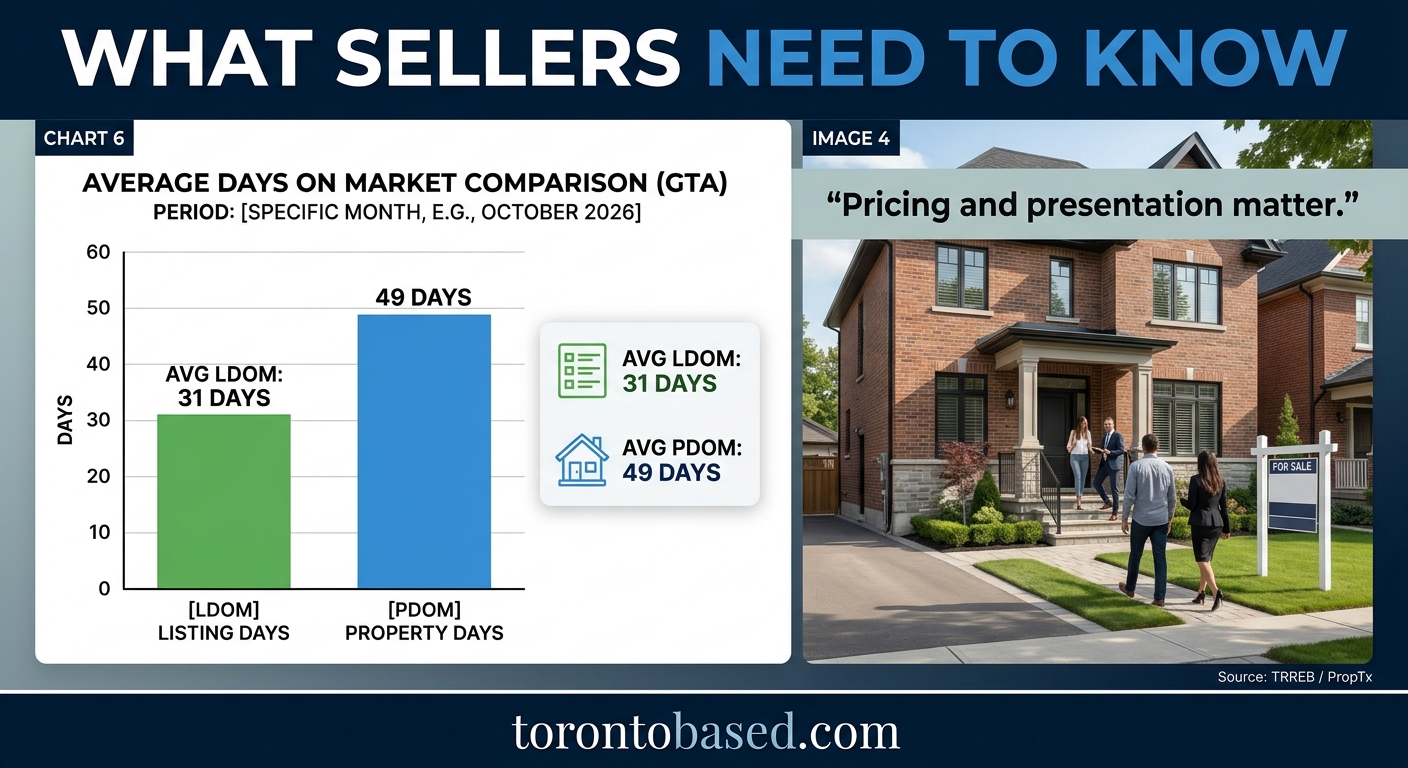
TRREB reported 5,603 firm sales, an average price of $1,024,108, 14,173 new listings and 25,098 active listings. The MLS HPI Composite benchmark was down 4.3% year over year. Average LDOM was 31 days and average PDOM was 49 days.

Why Are Home Sales Declining?

Sales dropped from 6,083 in October 2025 to 5,603 in October 2026. The decline means fewer transactions were completed, not that nobody wants to buy. Financing uncertainty is an important consideration. On October 28 the Bank of Canada raised its policy rate to 2.50%. Some potential buyers may be reassessing qualification, monthly costs and job security. Others may be waiting for greater clarity about future rates.

The market is not experiencing identical conditions in every community. Well-presented, competitively priced properties can still attract serious interest even when aggregate sales volumes decline.

GTA Home Prices: What Does the 2.7% Decline Really Mean?

The average selling price declined from $1,052,539 to $1,024,108—a difference of $28,431. However, average prices are influenced by which properties sell. A smaller share of high-value detached transactions can affect the overall average without representing the same percentage change for every home.

TRREB's MLS HPI Composite benchmark declined 4.3% year over year, offering a different measure of price movement. Seasonally adjusted benchmark and average prices edged higher from September, but that alone is insufficient evidence of a sustained recovery.

For homeowners, the GTA average is a market reference, not an appraisal. A property's estimated value requires recent comparable sales, competition, condition, size, location and buyer responses.

Fewer Listings: Could the Market Become More Balanced?

New listings fell 11.9%, from 16,080 to 14,173. Active listings declined 10%, to 25,098. These figures suggest that the supply side of the market is also contracting. Some owners may be delaying their plans, but monthly aggregate data cannot establish the motivations of individual sellers.

Shrinking supply can reduce buyer choice. Whether that eventually produces stronger prices depends on qualified demand relative to available properties. October's evidence indicates a changing balance, not a guaranteed imminent price increase.

Toronto, York, Peel and Durham: Different Local Markets

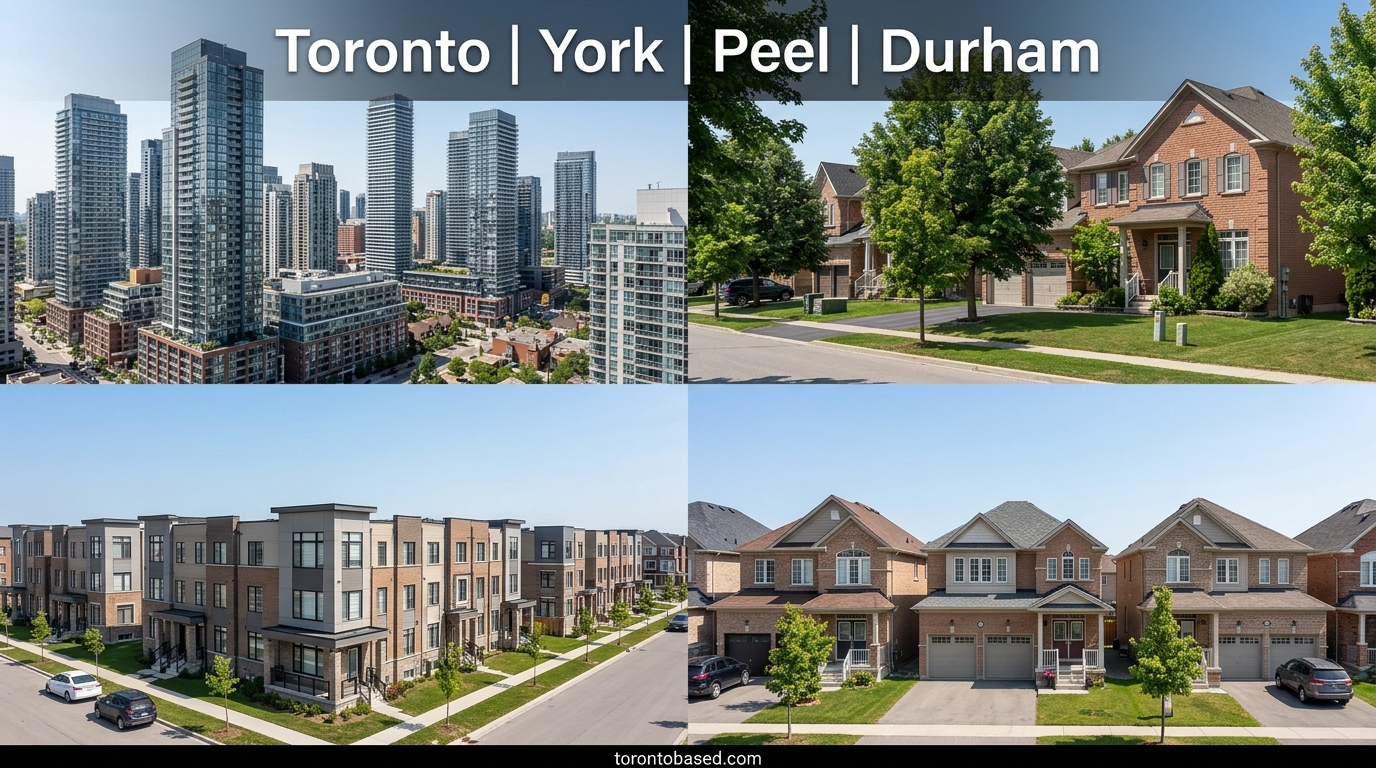
City of Toronto recorded 2,184 sales at an average selling price of $1,075,627; York Region recorded 1,038 sales at $1,142,789; Peel Region 1,017 at $898,431; Durham Region 589 at $793,024.

Toronto's market ranges from condominium apartments to expensive detached homes. Toronto Central averaged $1,185,407, Toronto East $948,682 and Toronto West $982,813. Such differences describe the mix of homes sold, not location premiums for otherwise identical properties.

York encompasses Markham, Richmond Hill, Vaughan, Aurora and other distinct municipalities. Peel includes Mississauga, Brampton and Caledon. Durham includes Pickering, Ajax, Whitby, Oshawa and Clarington. In every area, local comparable transactions matter more than a broad regional average for a particular purchase or listing.

Interest Rates, Inflation and Consumer Confidence

The Bank of Canada increased the overnight policy rate from 2.25% to 2.50% on October 28, 2026. September annual CPI inflation was 3.1%. Higher financing costs can affect qualification and purchasing budgets; inflation may also constrain the amount of income households can commit to housing. Fixed and variable mortgage products respond differently, and actual borrower terms vary by lender and borrower.

What October 2026 Means for Home Sellers

Sellers should price with recent firm comparable sales and current competition rather than relying on older market peaks. Buyers compare condition, size, floor plan, location, renovation costs and alternatives. Property preparation, photography, staging and a targeted marketing strategy can help a listing stand out.

Track market response and time on market closely. For owners planning to purchase another property, evaluate the entire move—including financing, carrying costs and replacement-property pricing—not just the sale-price headline.

What October 2026 Means for Buyers

Buyers may find negotiating opportunities in some segments but should begin with total affordability. In addition to mortgage payments, account for taxes, insurance, utilities, condominium fees, maintenance, closing costs and cash reserves. Review recent sales and complete suitable financing and property due diligence. Purchasing a suitable property at a sustainable cost matters more than trying to predict an exact market bottom.

What Investors Should Consider

Lower purchase prices do not automatically produce attractive investment returns. Evaluate rent, operating expenses, vacancy, financing, maintenance, taxes and applicable regulations. Model cash flow separately from speculative appreciation.

What Could Happen in 2027?

If inflation moderates and borrowing costs stabilize, confidence could improve. If uncertainty or financing costs rise further, activity may remain subdued. Continued reductions in new listings could tighten some neighbourhood markets. These are scenarios, not forecasts. The December 9 Bank of Canada decision and upcoming TRREB reports should be monitored.

Key Takeaways

1.        GTA sales decreased 7.9% year over year.

2.        Average price fell 2.7% to $1,024,108.

3.        MLS HPI benchmark declined 4.3%.

4.        New and active listings fell faster than sales.

5.        Seasonally adjusted monthly indicators improved modestly.

6.        Financing costs and economic confidence remain significant.

7.        Sellers need local pricing and preparation strategies.

8.        Buyers should focus on affordability and careful due diligence.

Frequently Asked Questions

What was the GTA average price? $1,024,108 in October 2026.

How many homes sold? 5,603, down 7.9% year over year.

Did prices increase? They remained lower annually, although seasonally adjusted averages rose modestly compared with September.

Is this a buyer's market? Conditions vary by neighbourhood and housing type; one GTA-wide statistic is insufficient to classify every submarket.

What was the Bank of Canada rate? 2.50% after October 28, 2026.

Should I sell now? Assess your local competition, objectives and finances.

Should I wait until 2027 to buy? There is no universally right answer; qualification, affordability and suitable inventory matter.

Conclusion

October 2026 reflects a GTA housing market still adjusting to economic uncertainty and changing borrowing costs. Annual sales and prices remain lower, but inventory declines and modest monthly improvements create a more nuanced picture. Buyers and sellers should base decisions on their specific neighbourhood, property type and financial objectives.


🏡 Ready to Start Your Real Estate Journey?
Whether you're planning to buy, sell, or invest, I’m here to guide you every step of the way — surprises and all.

📈 Looking to capitalize on today’s changing market?
Explore a wide range of specialized listings with access to powerful tools and search portals tailored to your needs:

Stay ahead of the curve. Get the latest real estate news and insights right here.


📩 Need help navigating your options?
Reach out for expert advice and market insights:

Sami Chowdhury
BROKER
📧 Email: samichy@torontobase.com
🌐 Web: www.torontobased.com | www.torontobase.ca

Let’s make your next move a smart one.


Get more market insights here:

·         Toronto & GTA Housing Market — Sep 2026

·         Toronto & GTA Housing Market — Aug 2026

Stay ahead of the curve. Get the latest real estate news and insights right here.


Read

How Alaska Counts Votes: A Different Election System That Could Change the Way America Chooses Its Leaders

Mary Peltola vs. Dan Sullivan: Why Alaska's 2026 Senate Election Is More Than Just a Close Political Race

When Americans go to the polls, most people understand the election process in a straightforward way. Voters select one candidate, election officials count the votes, and the candidate receiving the most votes wins.

But what happens when the leading candidate receives less than 50 percent of the votes?

In most American states, the answer is simple. The candidate with the highest number of votes wins, even if the majority of voters selected someone else.

Alaska follows a different approach.

The state uses a voting system called Ranked Choice Voting, which allows voters to rank candidates according to their preferences. If no candidate receives a majority in the first round, the election continues through additional rounds of counting.

The 2026 Alaska Senate election provides an excellent opportunity to understand this system.

According to the preliminary results displayed on November 5, Democratic candidate Mary Peltola was narrowly leading Republican incumbent Senator Dan Sullivan. However, neither candidate had reached 50 percent.

This raises an important question: What happens next?

To understand why the result may change, we first need to understand how Alaska's election system works.

Alaska's Election System: The Open Primary

Alaska introduced its current election system after voters approved Ballot Measure 2 in 2020.

One of the biggest changes was replacing traditional party based primaries with an open primary.

In many American states, political parties hold separate primary elections. Democrats choose their Democratic candidate, Republicans choose their Republican candidate, and other parties follow their own nomination procedures.

Alaska does things differently.

All candidates, regardless of political affiliation, compete in the same primary election.

For example, Democrats, Republicans, independents and candidates from other political parties can all appear on the same primary ballot.

Voters can choose any candidate, regardless of their own political party.

Once the primary votes are counted, the four candidates receiving the highest number of votes advance to the general election.

This means the four candidates moving forward could belong to different political parties. It is even possible for several candidates from the same party to advance.

The objective is to give voters more choices in the general election rather than limiting them to one candidate from each major party.

The General Election: Voters Rank Their Candidates

This is where Alaska becomes particularly different from most other states.

In a traditional election, voters select one candidate.

In Alaska, voters can rank candidates according to their preferences.

For example, imagine an election with four candidates:

Ranking

Candidate

First choice

Candidate A

Second choice

Candidate B

Third choice

Candidate C

Fourth choice

Candidate D

A voter who strongly prefers Candidate A can still indicate that Candidate B would be their next preference if Candidate A does not remain in the election.

Voters do not have to rank all four candidates. They can rank only one, two or three candidates if they wish.

This is an important feature because voters can support their favourite candidate without necessarily feeling that they are wasting their vote.

First Round: Counting the First Choices

After the election, officials count the first choice votes.

If one candidate receives more than 50 percent of the continuing votes, that candidate wins.

But what happens when nobody receives a majority?

That is exactly when ranked choice voting becomes important.

Instead of immediately declaring the candidate with the most votes the winner, election officials begin another round of counting.

The candidate with the fewest votes is eliminated.

Their ballots are then examined to determine which remaining candidate those voters ranked next.

Those votes are transferred to the next available preference.

How Are Votes Transferred?

Let's use a hypothetical election to understand the process.

Imagine four candidates receive the following first choice votes:

Candidate

First choice votes

Candidate A

42%

Candidate B

35%

Candidate C

15%

Candidate D

8%

Candidate A is leading, but has only 42 percent.

Nobody has reached a majority.

Under Alaska's system, Candidate D, who received the fewest votes, is eliminated.

Election officials then examine the ballots that originally selected Candidate D.

Imagine those voters ranked their remaining preferences as follows:

  • 5 percentage points next preferred Candidate A.

  • 2 percentage points next preferred Candidate B.

  • 1 percentage point next preferred Candidate C.

The votes are transferred.

The new results become:

Candidate

Votes after first transfer

Candidate A

47%

Candidate B

37%

Candidate C

16%

Nobody has reached 50 percent yet.

Candidate C is now in last place and is eliminated.

Officials examine the ballots that were originally assigned to Candidate C, including ballots transferred to Candidate C in the previous round.

Suppose their next available preferences produce these transfers:

  • 10 percentage points to Candidate A.

  • 6 percentage points to Candidate B.

The final result becomes:

Candidate

Final continuing votes

Candidate A

57%

Candidate B

43%

Candidate A wins.

Notice something important.

Candidate A started with 42 percent of the first choice votes. Candidate B started with 35 percent.

But the final result was determined by how voters ranked the candidates, not simply by who received the most first choice votes.

This is the central idea behind ranked choice voting.

The winner is determined through multiple rounds of counting, not necessarily by the first round alone.

What If Voters Do Not Rank Their Other Choices?

There is another important detail.

Voters are not required to rank every candidate.

Imagine someone votes for Candidate D as their first choice but does not rank anybody else.

When Candidate D is eliminated, that ballot has nowhere else to go.

The ballot becomes exhausted.

It is no longer included in the continuing vote total.

This means the majority threshold is calculated using the votes that remain active in the count, not necessarily every ballot originally cast.

For example, if 100,000 ballots were originally counted but 5,000 become exhausted, the continuing vote total is 95,000.

A candidate would need more than half of those 95,000 continuing votes to win.

This is an important distinction. A candidate can receive a majority of continuing votes without necessarily receiving more than 50 percent of all ballots originally cast.

6. Let's Apply This to Alaska's 2026 Senate Election

Now let's look at the actual preliminary results shown in the November 5 screenshot.

Candidate

Political party

Votes

Share

Mary Peltola

Democrat

102,962

48.2%

Dan Sullivan

Republican

102,325

47.9%

Gerald Heikes

Republican

4,846

2.2%

Daniel J. Sullivan

Independent

3,600

1.7%

At the time of this results snapshot, approximately 74 percent of votes were estimated to have been counted.

Mary Peltola was ahead of Republican incumbent Dan Sullivan by just 637 votes.

However, neither candidate had received more than 50 percent.

If the final first choice count remains without a majority, the ranked choice tabulation will begin.

Based on the current order, Daniel J. Sullivan would be the first candidate eliminated if he remains in fourth place.

His ballots would be examined and transferred according to the next available preferences marked by those voters.

Gerald Heikes could then be eliminated if he remains in third place.

His ballots would also be examined and transferred.

Eventually, only two candidates would remain: Mary Peltola and Dan Sullivan.

The candidate receiving more than 50 percent of the continuing votes would win.

But there is something we should not assume.

Gerald Heikes is a Republican, but that does not mean every voter who selected him will automatically transfer their vote to Dan Sullivan.

Some may have ranked Peltola second. Others may have ranked Daniel J. Sullivan second. Some may not have ranked another candidate at all.

The same principle applies to the independent candidate's supporters.

The voters' actual rankings, not the candidates' political affiliations, determine where the votes transfer.

That is why the final outcome cannot be predicted simply by adding the percentages of candidates from the same party.

How Is Alaska Different From Most Other American States?

To understand the difference, it helps to compare three common election approaches.

Traditional plurality voting

Most states use a system where voters select one candidate. The candidate with the highest number of votes wins, even without receiving 50 percent.

For example:


Candidate

Votes

Candidate A

40%

Candidate B

35%

Candidate C

25%

Candidate A wins, even though 60 percent of voters selected someone else.

Runoff elections

Some states require a separate runoff election if nobody reaches a specified threshold.

The two leading candidates face each other again, and voters return to the polls.

This requires another election, additional administration and another opportunity for voters to participate.

Alaska's ranked choice voting

Alaska allows voters to rank candidates during the original election.

If nobody receives a majority, the lowest candidates are eliminated in successive rounds. Votes are transferred according to the rankings already provided.

There is no need to organize a second election.

Feature

Traditional plurality

Runoff election

Alaska ranked choice

Voters select one candidate

Yes

Usually

No, they can rank candidates

More than 50% required

Usually no

Depends on state rules

Majority of continuing votes

Additional election needed

No

Yes

No

Votes transferred

No

No

Yes

Multiple counting rounds

No

Separate election

Yes

Not every state uses identical election rules. Some have different primary systems and different requirements for runoffs. But this comparison illustrates the major differences.

When Will Alaska Know the Final Winner?

Election night results are not necessarily the final results.

Alaska has to process outstanding ballots, including eligible absentee ballots and other ballots that require review.

The state also has a specific timetable for its ranked choice tabulation.

Under Alaska's election procedures, the ranked choice tabulation is generally scheduled no earlier than 15 days after Election Day, once the necessary ballot counting and review have taken place.

That means the first choice results may be available much earlier than the final ranked choice outcome.

For the November 3, 2026 election, the official election calendar and any applicable deadlines should be checked before announcing a precise date.

This is why the first place candidate on election night may not necessarily become the final winner.

Alaska Has Already Faced a Debate Over Its Election System

Ranked choice voting has supporters and critics.

Alaska voters approved the new system in 2020.

However, the system faced a major political challenge in 2024 when voters considered a proposal to repeal it.

The repeal measure was narrowly defeated, allowing the system to remain in place.

Supporters argue that ranked choice voting gives people more choices, encourages candidates to appeal to a broader electorate and reduces the fear of wasting a vote on an independent or less popular candidate.

Critics argue that it makes elections more complicated, requires additional voter education and can make the counting process less straightforward.

These are important concerns.

For any voting system to work effectively, voters must understand how it operates and have confidence in the counting process.

Could Other States Learn From Alaska?

The biggest question is whether other American states should consider adopting ranked choice voting.

There are potential advantages.

First, voters can support their preferred candidate without necessarily feeling that they are helping elect someone they strongly oppose.

Second, candidates may have an incentive to appeal to voters beyond their traditional political base because they may need to become someone's second or third choice.

Third, independent candidates may have more opportunities to participate in competitive elections.

However, ranked choice voting does not automatically solve political polarization, misinformation or declining public trust.

A voting system alone cannot fix every problem in a democracy.

It is also important to remember that a candidate winning under a plurality system is not necessarily an illegitimate winner. The rules of that election determine how the result is decided.

The question is whether a different system might provide voters with more meaningful choices.

Democracy Is Also About How We Count Votes

The 2026 Alaska Senate election is an interesting reminder that election rules matter.

Mary Peltola's narrow lead over Dan Sullivan in the preliminary results does not tell the complete story. If neither candidate receives a majority in the final first choice count, the ranked choice process will determine the outcome.

This gives Alaska a different way of measuring voter preferences.

Whether other states should follow Alaska's example is a debate worth having.

The goal of an election should not be to benefit one political party or another. It should be to ensure that voters have a fair opportunity to choose their representatives and that the rules are transparent and understandable.

Democracy is not only about who receives the most votes. It is also about how those votes are counted and how the choices of the people are represented.

 Sami Chowdhury, 6 November 2026

TORONTOBASED.COM 

Read
This website may only be used by consumers that have a bona fide interest in the purchase, sale, or lease of real estate of the type being offered via the website. The data relating to real estate on this website comes in part from the MLS® Reciprocity program of the PropTx MLS®. The data is deemed reliable but is not guaranteed to be accurate.