
Introduction: From Fog to Fresh Water
High in the arid hills above Lima and Arequipa, Peru, a quiet revolution is underway. Where rainfall is scarce and rivers are distant, engineers and villagers are working together to harvest water directly from the air. Their tool isn’t a machine or a pipe — it’s a net.
These vertical fog-catching systems, often several meters tall, stand like sentinels in the mist. The nets, sometimes coated with biomimetic materials such as cactus fiber, capture microscopic droplets from the air. The moisture condenses, drips into gutters, and is stored in tanks for drinking, irrigation, and livestock.
Each installation can collect 300–400 liters per day, and when scaled across dozens of nets, these systems can support entire communities. What began as a grassroots idea is now inspiring countries from Morocco and Chile to Namibia and India — all searching for new ways to survive water scarcity.
1. The Global Water Crisis — and Why Fog Matters
Water scarcity affects more than 2 billion people globally. Many live in regions that receive less than 250 mm of rain per year — technically deserts — yet remain rich in fog and humidity.
Peru’s Pacific coast is a textbook example: it’s one of the driest deserts in the world, but dense coastal fog, known locally as “garúa,” forms almost daily from May to November.
Traditional water systems fail here. Wells hit salty groundwater; rainfall is rare; and water trucks are expensive. For years, Lima’s poorest residents paid up to ten times more per liter for trucked water than wealthier neighborhoods with city connections.
So locals began to ask: if fog wets your clothes and coats the hills in dew, could it fill your buckets too?
2. How Fog Nets Work
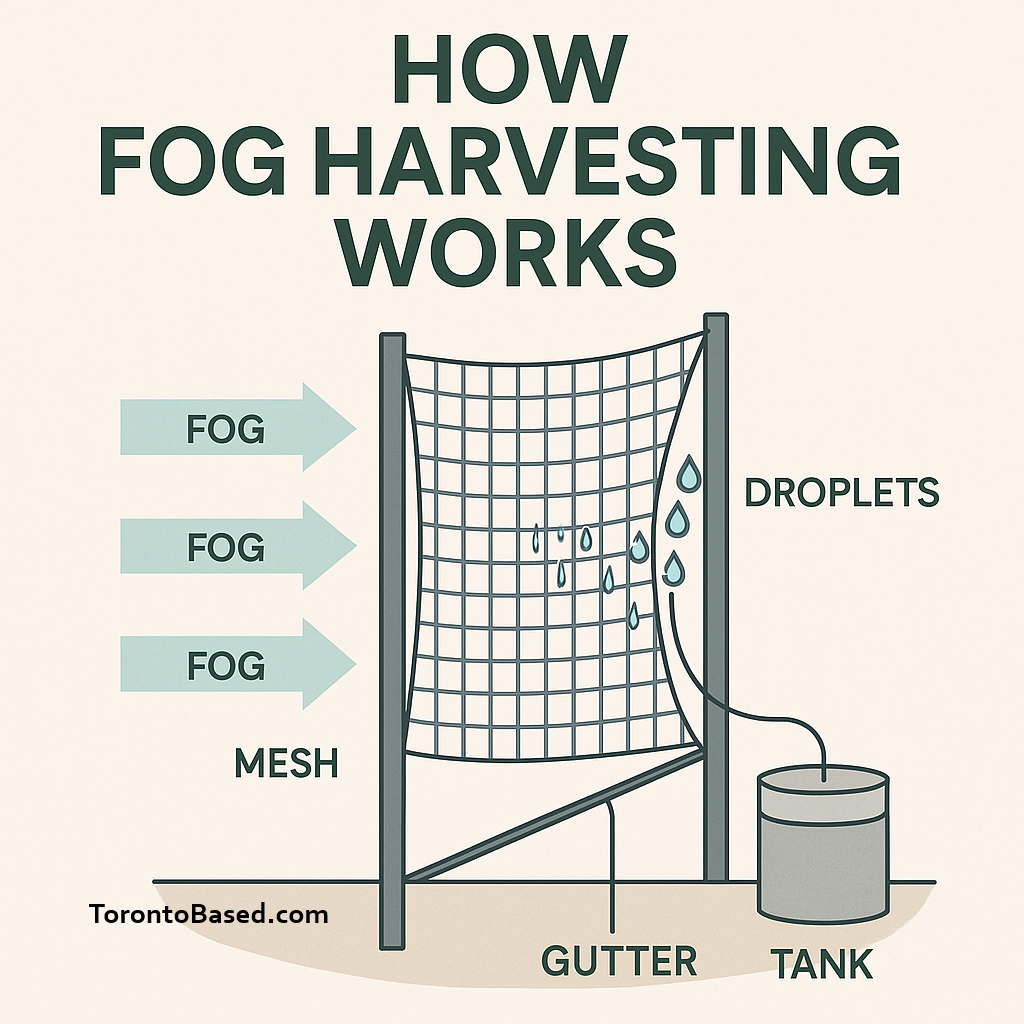
Fog is essentially a cloud at ground level, made of tiny suspended water droplets. When this moist air passes through a fine mesh, droplets collide with the fibers, merge, and drip down.
A fog-harvesting system typically consists of:
A vertical mesh panel, 4–10 m wide and several meters tall
A collection trough at the base to channel water into storage
Support poles and anchors to resist high winds
Storage tanks for collected water
Studies by Otto Klemm et al. (Ecohydrology & Hydrobiology, 2012) found that each square meter of mesh can yield 3–10 liters of water per day under good conditions. That may sound small, but on a 40 m² system, it means 120–400 liters daily — enough for a household’s needs in rural Peru.
👉 Source: Ecohydrology & Hydrobiology – Fog as a Fresh-Water Resource (PMC3357847)
3. Lima’s Hills: Communities Leading Innovation
On Lima’s outskirts, thousands of families live in hillside settlements without running water. In Villa María del Triunfo, a network of fog catchers now stretches across the ridge — shimmering green against the brown desert.
Local NGO Movimiento Peruanos Sin Agua, founded by engineer Abel Cruz, has built over 600 fog collectors in the area. Each one costs around $600–800 USD and can provide up to 400 liters of water per day. The community uses the water for washing, irrigation, and — after filtration — drinking.
According to the London School of Economics (LSE) Latin America blog, just 23 fog catchers installed in 2020 provided over 10,000 liters per day for 60 residents, surpassing the World Health Organization’s recommended per-person water minimum of 50 liters daily.
👉 Source: LSE Latin America Blog – How Fog Catchers Improve Water Scarcity
4. The Science Behind the Nets
The efficiency of fog nets depends on climate, topography, and materials.
Ideal Conditions
Frequent fog events (especially coastal or mountain fogs)
Consistent wind speeds (3–10 m/s)
Elevated terrain perpendicular to prevailing winds
Materials and Design
Modern fog nets use polypropylene Raschel mesh, which balances capture efficiency and drainage. Researchers have experimented with hydrophilic and cactus-inspired coatings, improving droplet adhesion and flow. The “CloudFisher” design, used in Morocco, withstands winds up to 120 km/h while capturing 30–60 liters per day per net.
👉 Source: WasserStiftung – CloudFisher Project
In Peru, similar adaptations — including cactus fiber–based coatings and improved gutter systems — have increased yields and reduced maintenance. These biomimetic approaches echo the desert plants’ natural ability to collect dew.
5. Measured Impact: Data from the Field
These results demonstrate that fog nets can move beyond pilot projects and support long-term community infrastructure.
6. Social Dimensions: Ownership, Fairness, and Trust
As successful as the technology is, fog harvesting only endures when communities trust the process.
In earlier projects, lack of training or local ownership led to neglect and system failure. By contrast, Abel Cruz’s model prioritizes local leadership — training residents to install, maintain, and manage distribution.
The Frontiers in Water (2021) journal emphasized that social and institutional factors — governance, gender inclusion, and transparent management — are as vital as engineering performance.
👉 Source: Frontiers in Water – Review of Fog Water Harvesting Systems
This alignment of community, science, and policy fosters not only sustainability but trust — the cornerstone of any shared resource.

7. Beyond Peru: Fog Harvesting Around the World
Peru’s success has inspired similar efforts globally:
Chile (Atacama Desert) – Pioneering fog-catching systems since the 1990s, generating up to 10,000 liters/day for local villages.
Morocco (Mount Boutmezguida) – The world’s largest fog project supplies over 1,600 villagers with fresh water.
Eritrea & Ethiopia – Pilot projects serve schools and pastoral communities.
India (Rajasthan) – Researchers adapting CloudFisher models for monsoon off-seasons.
👉 Source: ActiveSustainability – Fog Catchers: A Solution for Drought
Globally, scientists estimate that scaling up fog collection in suitable zones could yield tens of millions of liters per day — enough to supplement water supply for hundreds of thousands of people.
8. Environmental and Economic Benefits
Environmental
No energy input: Fog nets are passive, requiring no electricity.
Carbon-neutral: No emissions from pumping or treatment.
Ecosystem support: Restores vegetation and reduces soil erosion in fog-fed “lomas.”
Economic
Low cost: $600–1,000 USD per collector, lasting 10+ years.
Low maintenance: Simple cleaning and re-tensioning.
Reduced dependence: Communities save up to 80% on purchased water.
Public Health
Access to clean water improves hygiene, reduces disease, and empowers women and children who often bear the burden of water collection.
9. Limitations and Real-World Challenges
Fog harvesting isn’t a silver bullet. Key limitations include:
Seasonal variability: Lima’s fog season lasts about eight months; production drops during hot, dry periods.
Maintenance needs: Dust, insects, and damage can reduce output.
Water quality: Fog water must be tested for airborne pollutants before consumption.
Scalability: Logistics for storage and distribution remain complex for larger populations.
Yet, despite these challenges, fog nets often provide a lifeline — especially in regions where no other sustainable water option exists.
10. Lessons for Policymakers and Planners
Assess microclimate data before investing — fog frequency and wind direction dictate success.
Incentivize local manufacturing of fog nets to reduce costs.
Integrate fog harvesting into water policy under climate adaptation strategies.
Create maintenance training programs and community management structures.
Provide micro-finance or subsidy models to empower self-installations.
Inclusion in national climate-resilience programs could bring fog-harvesting from niche innovation to mainstream sustainability.
11. The Cactus Connection: Nature Inspires Technology
Nature has long mastered water collection. In the Peruvian desert, cacti and desert beetles capture dew and fog using micro-grooved surfaces that channel water droplets toward their roots or mouths.
Engineers now mimic these surfaces using cactus fiber coatings or hydrophilic polymers on mesh nets. Early research from arXiv (2024) demonstrates that changing fiber shape and wettability dramatically improves droplet flow and reduces clogging.
👉 Source: arXiv – Mesh Design for Fog Harvesting (2024)
By learning from desert plants, humans are building systems that can transform fog into fresh water more efficiently — using the same principles nature has used for millions of years.
12. A Model for Global Resilience
As climate change intensifies droughts, fog harvesting offers hope for communities from North Africa to South America.
It proves that sustainability doesn’t always require advanced technology — sometimes, it’s about harnessing what’s already in the air.
With proper design, community involvement, and long-term policy support, fog nets could supply millions of liters of clean water every day — helping nations achieve UN Sustainable Development Goal 6: Clean Water and Sanitation.
Conclusion: Turning Mist into Trust
The fog nets of Peru aren’t just collecting water — they’re collecting trust, dignity, and independence.
They show that resilience begins not with wealth or infrastructure, but with ingenuity and cooperation. In a world growing hotter and drier, these green nets on desert hillsides stand as a powerful reminder: even in the absence of rain, there is always hope in the air.
Full Reference List
Klemm, O., Schemenauer, R., et al. “Fog as a Fresh-Water Resource.” Ecohydrology & Hydrobiology, 2012. PMC
Frontiers in Water. “Fog Water Harvesting Systems: Review of Research and Practice.” 2021. Frontiers in Water
LSE Latin America Blog. “How Fog Catchers Improve Water Scarcity in Urban Settlements in Peru.” 2023. LSE Blog
ActiveSustainability. “Fog Catchers: A Solution for Collecting Water in Times of Drought.” ActiveSustainability.com
National Geographic. “The Delicate Art of Catching Fog in the Desert.” March 2023. NationalGeographic.com
Columbia Climate School. “The Fog Collectors: Harvesting Water from Thin Air.” 2011. Columbia.edu
Munich Re Foundation. “Fog Nets – Harvesting Drinking Water from Fog.” MunichRe-Foundation.org
WasserStiftung. “CloudFisher Project.” WasserStiftung.de
ArXiv Preprint (2024). “Droplet Morphology-Based Mesh Design for Fog Harvesting.” arxiv.org/abs/2401.05284
Wikipedia. “Fog Collection.” en.wikipedia.org/wiki/Fog_collection
🏡 Ready to Start Your Real Estate Journey?
Whether you're planning to buy, sell, or invest, I’m here to guide you every step of the way — surprises and all.
📈 Looking to capitalize on today’s changing market?
Explore a wide range of specialized listings with access to powerful tools and search portals tailored to your needs:
· Stay ahead of the curve! Get the latest real estate news and insights right here.
📩 Need help navigating your options?
Reach out for expert advice and market insights:
Sami Chowdhury
BROKER
📧 Email: samichy@torontobase.com
🌐 Web: www.torontobased.com | www.torontobase.ca
Let’s make your next move a smart one!
Get more market insights here.
· Renting vs. Owning: How $2,500/Month Could Cost You $190,000
· Toronto & Greater Toronto Area (GTA) Housing Market — September 2025
· Canada’s Economy Rebounds in July: Signs of Resilience Despite U.S. Tariffs
· GTA Housing Market Update – August 2025
· Ontario’s Housing Crunch: What’s Really Going On
· Canada’s Economy Stumbles in August: 66,000 Jobs Lost, Unemployment Soars to 7.1%
· Durham Region Real Estate Market Report – July 2025
· Hamilton Real Estate Market Update – July 2025
· GTA Real Estate Market Report – July 2025
· Woodbridge Square Redevelopment: Vaughan’s New Urban Vision
· Unlock the Full Potential of 977 O’Connor Drive: A Prime Restaurant Opportunity
· Greater Toronto Area (GTA) Housing Market Update – May 2025
· GTA Condominium Market Analysis – April 2025
· Ontario Eliminates Tolls on Highways 412 and 418, Extends Gas Tax Relief
· Stay ahead of the curve! Get the latest real estate news and insights right here.